ABZÛ, one of my favorite games, is an epic descent into the depths of the sea, where players will explore beautifully rendered ocean environments with fluid swimming controls. It doesn’t have UI elements, since it’s kind of game with no clear plot. The primary objective of the game is to discover and unlock specific waypoints located on the map. Unlocking these waypoints is a straightforward process as the game is not intended to be challenging. Abzu stands out as a visually stunning game, emphasizing its design. Each unlocked waypoint rewards you with a breathtaking visual elements.
In this type of games, UI elements are often considered unnecessary. However, I believe that even if a game has very few tasks or is entirely exploration-focused, it should still have UI elements. Offering two options to players, such as making the UI transparent or visible, seems necessary for every game. So, I focused on that idea in this case study.
Research Methods:
— Contextual Inquiry
— User-Testing
— Interviewing
Tools:
— Figma
— Adobe Photoshop
The Challenge:
Designing UI Elements for the game.

1. DISCOVERY, RESEARCH AND USER TESTING
I began the process with understanding needs of players. In order to find out this, I conducted a small-scale user-testing with two participants. While interviewing with them, my main purposes were:
- Understanding the challenges they experience while playing the game
- Discovering their expectations on game’s HUD/UI elements
I conducted user-testing with 2 individuals. One of them is an inexperienced gamer, the other participant has more experience but has never played a game like ABZU. I requested them to play the game and document their emotions and experiences during gameplay. I asked them to identify the parts that were challenging or frustrating, as well as the parts that were easy or enjoyable. Additionally, I inquired if there were any aspects they wished were different or had suggestions for improvement. Emerging themes during the interviews can be seen below.
- Optinal HUD elements can be useful. Puzzle parts and some levels/waypoints in the game (especially where the players have to find ropes and open the doors with them) might be a little difficult for an inexperienced player. So, some reminders can be added to the HUD screen and seeing them can be optional.
- Meditation might be a must for the character. Our main character, the diver could get tired of swimming and need to sit somewhere and meditate. Knowing that the diver is tired and should take a rest by meditating makes this process more relaxing for players too as it reflects directly to players’ empathy.
- Increasing players’ empathy to diver can increase the gameplay quality. Empathy and attention are two directly influencing factors. If the player can establish empathy, particularly with the main character, their interest and attention towards the game are likely to increase. The mentioned aspect above, emphasizing the need for the character to meditate when they get tired, can contribute to increasing empathy. Additionally, if the character is given a backstory or if they exhibit emotional responses and reactions when encountering traces of their ancestors in ancient relics, these can also play a role in enhancing empathy and attention from the player’s perspective.
- The diver could encounter with more challenge. ABZU have some difficulties for an individual with a little or no gaming experience. But in general, its kind of game which involves no challenge.
In the light of the emerging themes, I decided to focus on two things: 1. Adding a button to HUD screen to see the options. 2. Designing a diegetic UI.
2. WIREFRAMING AND PROTOTYPING
I sketched out my ideas in my sketchbook to get a rough idea of how the play screen would look. I tried to add some elements to HUD.

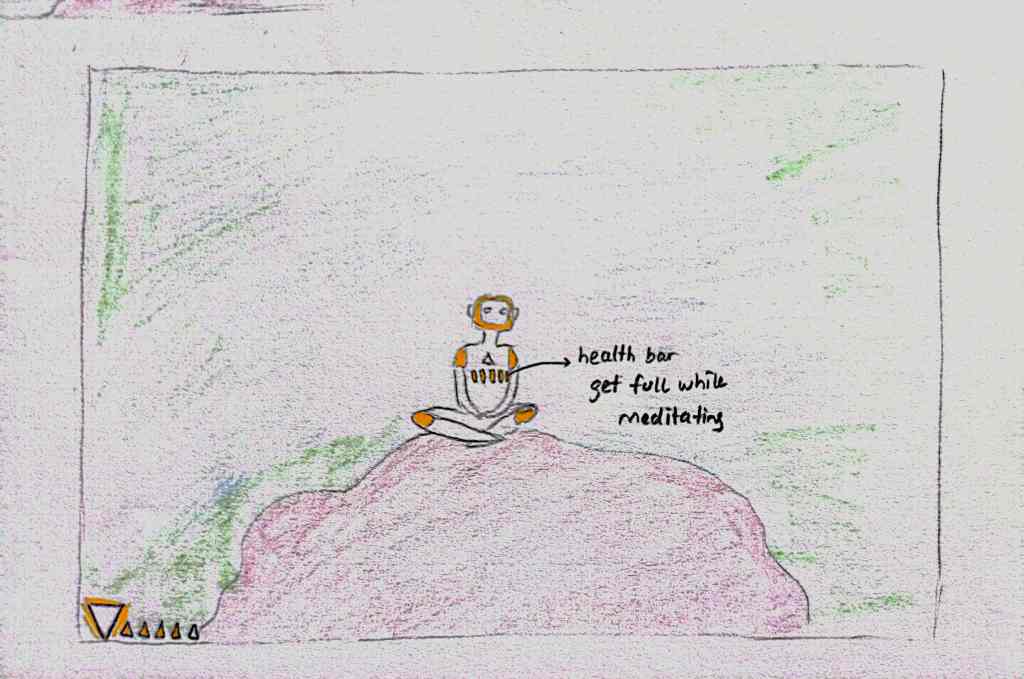
As known, the purpose of a “heads-up display” is to prevent users from having to remember important information or search for it. While a clunky and overwhelming HUD should be avoided; removing it entirely could create more friction, cognitive load, and less immersion for players. This is because they would need to open menus to access important information, which pulls them out of the game world. Instead, game developers should strive to create a context-sensitive HUD that offers useful information at the right time. If possible, they can also use a “diegetic” interface that integrates information directly into the game world. An example of an efficient and elegant diegetic UI is the health system in Dead Space, where the health gauge is integrated into the character model itself.
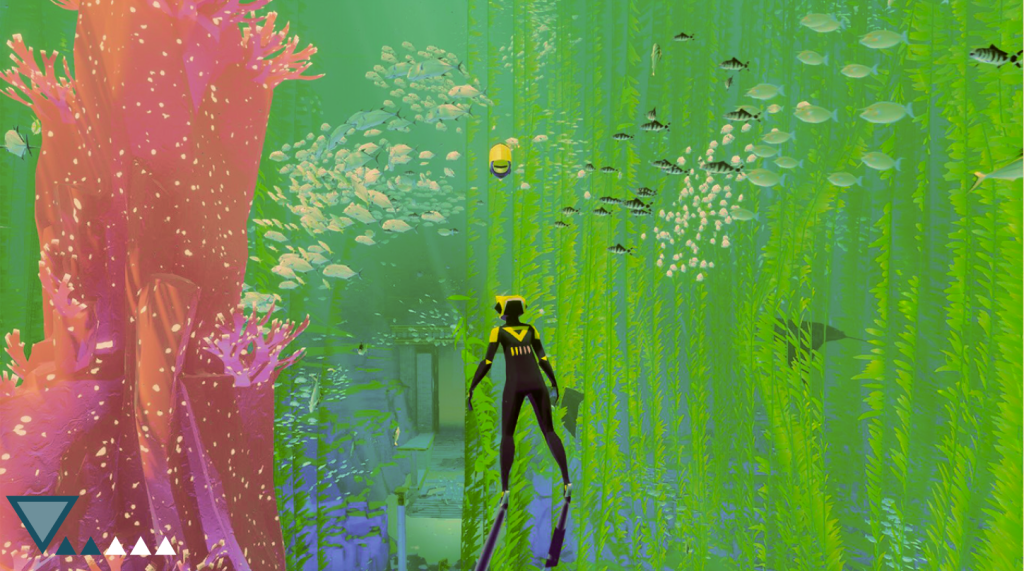
I inspired from Dead Space’s health gauge design and tried to adapt it to ABZU (actually, for it’s different version where the diver can get tired). Also, I tried to add little triangles to letf bottom of HUD. The bigger one represents the options-button. Other ones are levels/waypoints of the game. As the player move on to the other level, one of the tiny triangles turns into a different color.
After wireframing, I created these prototypes via Photoshop and Figma.

 Sena Dökmeci